(ASSUMED)
 |
The official U.S. sword regulations for 1832 dictated a yellow mounted
small sword for medical staff - "Small sword, gilt hilt and mountings
with black scabbard and belt." This regulation was in effect until
1840 and specimens of the medical sword are very rare. Specimens
of the Pay Department sword are unheard of. The medical sword pictured
in The American Sword 1775-1945 book by Peterson bears an etching
of the bust of "Esculapius," an ancient physician, and it is labeled
as such. The example in the book also bears the letters "U. S."
surrounded by a wreath. Floral and military etchings are in evidence.
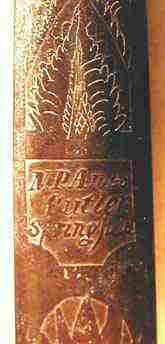
The U.S. Pay Department sword regulations use the same description: "Small sword, gilt hilt and mountings, black leather scabbard." The sword pictured on this web page does not have the markings as described for the medical staff sword. It is marked, on the obverse, "N.P. Ames/Cutler/Springfield" in 3 lines as opposed to the 2 line marking on the medical staff sword as described.
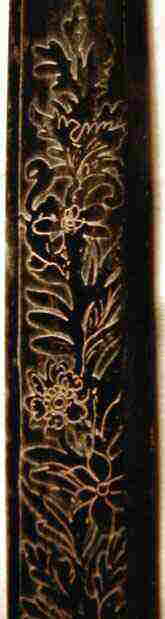
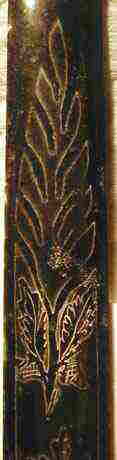
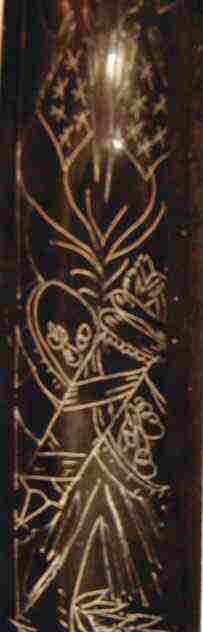
There is no U.S. markings. The carbon darkened blade is profusely
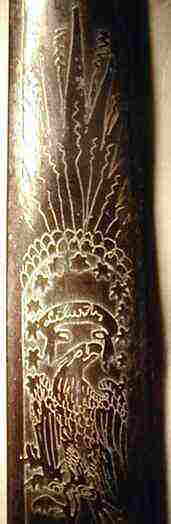
etched. On the obverse side there is a liberty cap surmounting
2 crossed American flags with cannon and a seated eagle in a panoply
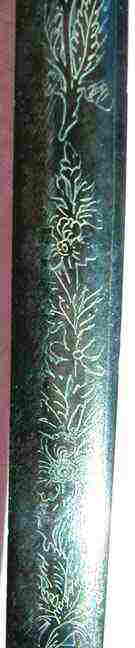
of stars under a ribbon with "Liberty" on it. Floral designs separate
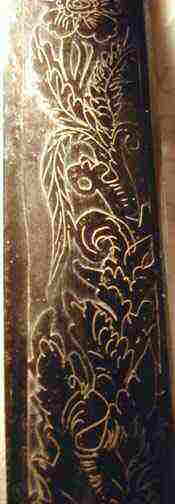
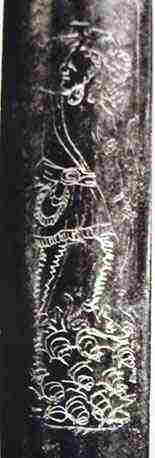
the etchings. On the reverse side there is standing indian with
lifted tomahawk (Tecumseh?), a shield with a stars and stripes
design under a raised liberty cap and another seated eagle etching
along with much floral designs. . |
|
|
| Obverse View of the hilt | 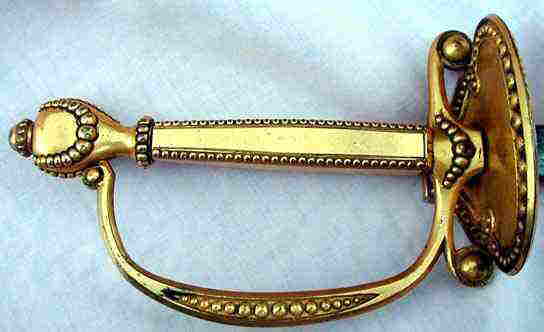 |
||
| Reverse View of the hilt |  |
||
| Top View of the hilt | 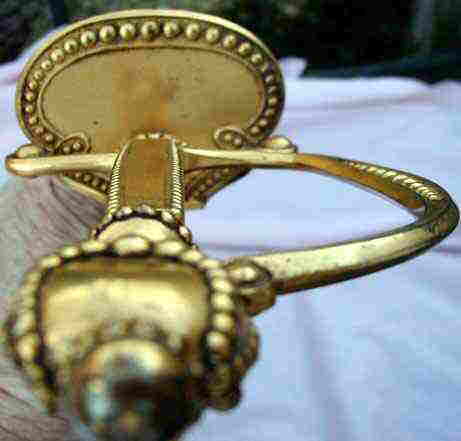 |
||
| Bottom View of the hilt | 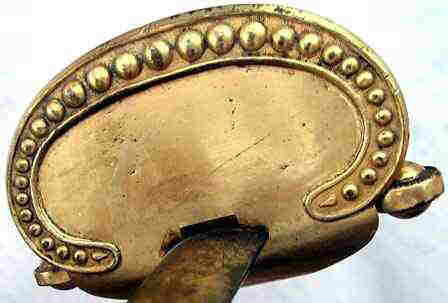 |
||
 |
By deduction, we are assuming this example to be a possible Pay
Department (Paymaster) sword. It meets the regulations and it likely
not a medical sword. Since 1832, the medical and pay departments
have worn the same swords differing only in blade etchings and the
letters MS or PD laid unto or cast into the hilt as with the Model
of 1840.
The double-edged elliptical shaped blade is 30-5/16" in length. It is ¾" wide at the hilt and tapers evenly to it's point. The hilt, from the top of the blade nut to the bottom of the guard is 6-1/8" bringing the overall length to 36-7/16". The gripping area of the hilt is 4". The outside quillion to quillion measurement is 3-5/16". The shell counter guard is 3" across and extends outward, from the blade for 1½". Please be aware that the 5 piece handle of this sword can be easily disassembled. There is a chance that the blade may have been reversed at one time. The obverse and reverse sides referred to in this write-up are based on the present assembly of the sword.
The obverse side of a sword blade would be the side facing you,
in an horizontal position, with the blade to your right and the
hilt to your left. The side away from you would be the reverse.
|
 |
|
 |
 |
 |
 |
Dave Radcliffe